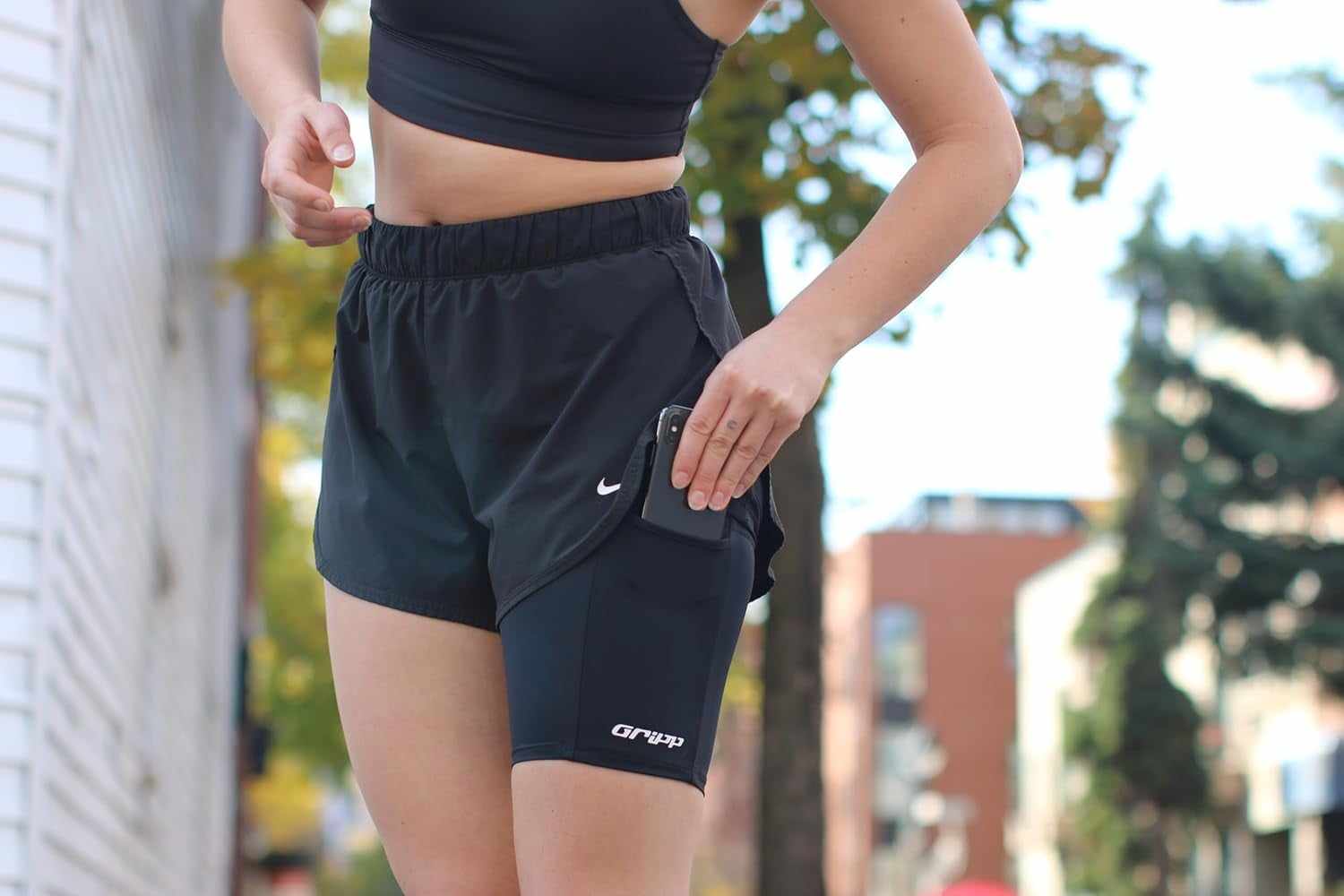
Quick answer: If your running shorts have no pocket, or the pocket is too small, shallow or loose for your actual phone and case, treat it as no secure pocket. For one phone, start with a secure compression pocket you already own, comfortable hand carry for a short run, or a close-fitting armband or thigh holder. If you also carry keys, cards or gels, use a fitted running belt or split the items between secure locations. If water or layers are part of the load, a running vest is usually the more practical category.
The useful test is simple: the pocket or holder should fully contain your phone, stay where you placed it during movement and give you the access you need. Test the complete setup before relying on it for a full run.
First, decide whether the pocket is actually secure
A pocket exists only as useful phone storage if it works with your actual phone and case. A zipper can help close an opening, but it does not guarantee that the pocket is deep enough, that the phone sits flat or that the shorts remain stable.
- Put your actual phone and case in the pocket.
- Confirm that the phone is fully contained and any closure works without forcing it.
- Walk, jog, sit and change direction.
- Check whether the phone shifts, pulls the waistband or needs repeated adjustment.
- Try the access you expect to need, such as a route check or audio control.
If the phone is partly exposed, the closure does not work, or the shorts move in a way you do not accept, treat that pocket as unavailable and choose another location.
Choose by what you actually carry
| Your load | Start here | Other useful option | Check before running |
|---|---|---|---|
| One phone | Secure compression pocket | Armband or thigh holder | Phone and case fit, closure, access and movement |
| Phone plus a key, card or gel | Fitted running belt | Split items between two secure locations | Total load and whether hard items press together |
| Phone plus water or layers | Running vest | Belt with enough capacity | Full-load fit, closure and access |
| Occasional short run | Comfortable hand carry | A holder you already own | Whether you can carry it without constant gripping or adjustment |
Start with clothing you already own
If you own compression shorts with a phone pocket, test those first. A close pocket that fully contains the phone can be the lowest-cost option because it adds no accessory. Repeat the test with every pair you plan to use. Pocket size and placement can differ even when the shorts look similar.
If your broader question is how to choose among all carry locations, use the practical phone-carry guide to compare options by total load, clothing and access.
Hand carry can work for a short run
You do not need to buy a holder for every run. If carrying the phone in your hand feels comfortable and does not require constant gripping or adjustment, it may be enough for a short outing. If you want both hands free or keep checking your grip, move the phone to clothing or a holder.
Use a belt when the phone is not your only item
A fitted running belt becomes more useful when you also carry a key, card, gels or another small item. Test it fully loaded. Keep hard objects from stacking directly against the phone, and check whether the belt stays where you placed it.
A belt is not automatically the best phone-only answer. It is a storage category for a larger small-item load. If movement is the issue, use the phone-bounce troubleshooting guide before replacing your gear.
Compare an armband and a thigh holder for phone-only carry
Both options move the phone out of your shorts. The useful differences are placement, phone and case fit, body fit and screen access. An armband keeps the phone on the upper arm. A thigh holder keeps it on the upper leg. Neither category replaces an actual movement test.
If you prefer upper-thigh placement, the 800m THIGHBAND is a phone-only option worn high on the thigh. Check the product size, body fit and your actual phone plus case. Its silicone grip is intended for bare skin, not over leggings.
For a category-level comparison, see belt vs armband vs thigh holder.
Use a vest when the load includes water or layers
A running vest is usually more equipment than a phone-only run needs. It becomes practical when water, food or clothing layers are already part of the plan. Put the phone in a pocket that fully contains it, then test access and movement with the vest loaded as it will be during the run.
Run a five-minute setup test
- Load your actual phone, case and every other item.
- Walk, jog and change pace for a few minutes.
- Check whether the phone moves, presses awkwardly or needs repeated adjustment.
- Use the access you expect to need.
- Change the location, load or fit if the setup does not work for you.
This test is more useful than choosing by the product category alone. A secure pocket can be simpler than a holder. A phone-only holder can be smaller than a belt. A vest can be the right answer when the load has already grown beyond the phone.
Where THIGHBAND fits
THIGHBAND is most relevant when your shorts have no secure phone pocket, you mainly carry one phone and you prefer upper-thigh placement over an arm or waist holder. It is not the right category for carrying water or a collection of small items. It is also not designed to grip over leggings.
The decision comes down to four checks: body size, phone and case fit, bare-skin placement and real movement. If those do not match your run, choose a secure pocket, belt, vest or another holder instead.
FAQ
Where should I put my phone if my running shorts have no secure pocket?
For one phone, try a secure compression pocket, comfortable hand carry, an armband or a thigh holder. Use a fitted belt for extra small items and a vest when you also carry water or layers.
Is a zippered pocket always secure enough for a phone?
No. The pocket still needs to fully contain your actual phone and case, close without forcing and stay stable during movement. Test it before a full run.
What if the phone fits but pulls down the shorts?
Treat the pocket as unusable for that setup. Try different shorts, move the phone to a fitted holder, or use a belt or vest that matches the total load.
Is a running belt better than a thigh phone holder?
A belt offers more storage. A thigh holder is a phone-only option that keeps the device away from the waist. Choose based on total load, body fit and access.
What if my phone has a bulky case?
Test the phone and case together. A product label does not replace checking the actual pocket opening, closure and movement.