Biomechanics Guide Phone holder Run
Apr 25, 2026 · Updated Apr 28, 2026

How Should You Carry Your Phone While Running? A Biomechanics Guide

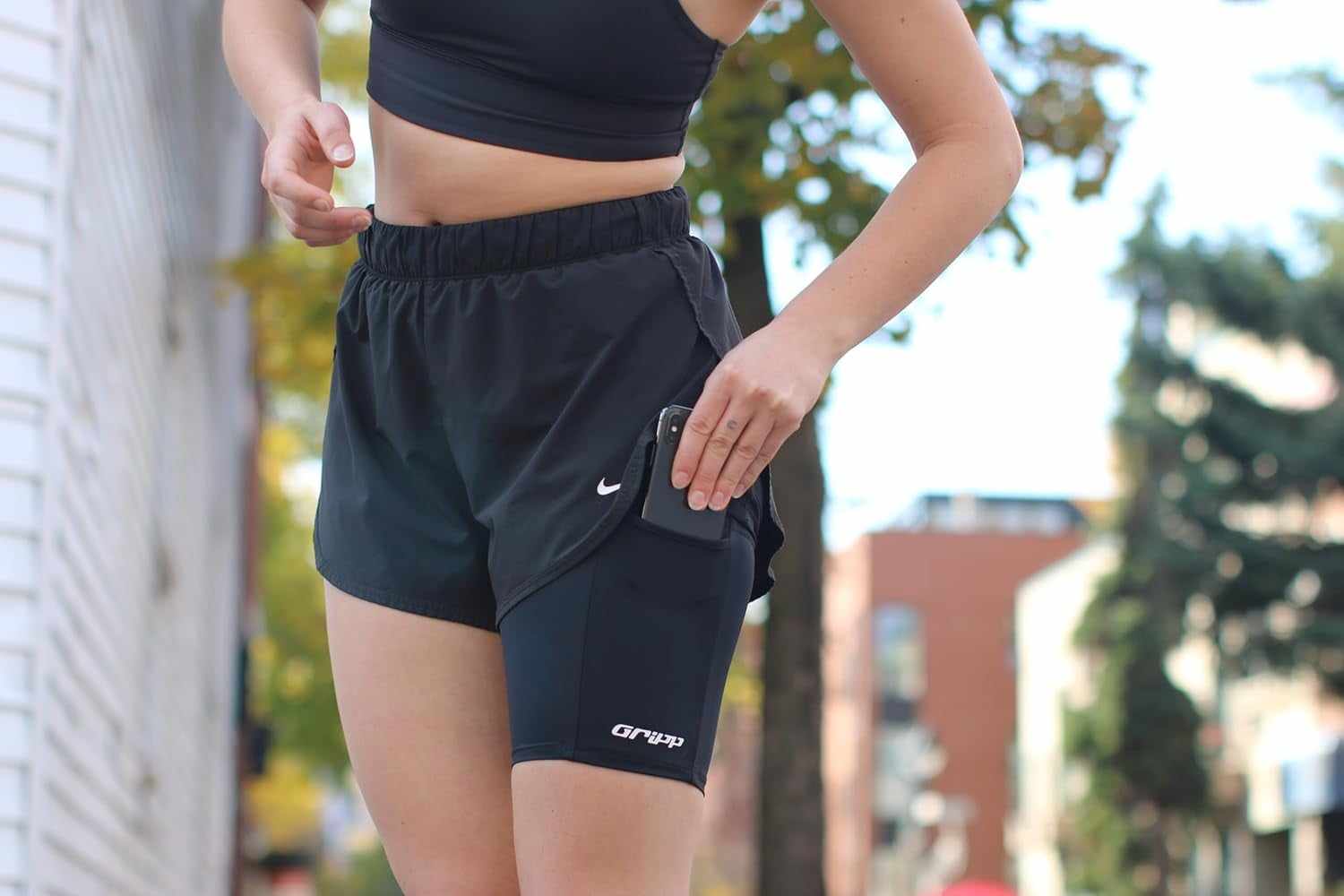
Two runners in an urban setting; one is wearing the 800m thigh phone holder under running shorts

By Samuel Audette, Cofounder of 800m · Last updated: April 28, 2026 · Reading time: ~10 minutes


TL;DR

The best place to carry your phone while running is high on your thigh, secured by a wide silicone-banded holder. Thigh placement minimizes vertical bounce — a major cause of running distraction — keeps weight close to your body’s center of mass, and works with any wardrobe (shorts, leggings, dresses, or skirts). Armbands slip, belts bounce, and your hand gets tired. After cycling through roughly 20 prototypes tested on several hundred runners, we built 800m for exactly this answer.


Why does where you carry your phone actually matter while running?

A modern smartphone weighs between 170 and 230 grams. That’s small in your living room — but on a long run, every foot-strike sends a ground-reaction impact through your body, and there are thousands of them in even a moderate session. Every one of those impacts is going to drive your phone somewhere unless it’s stabilized.

If your phone moves with each stride — bouncing in a pocket, sliding down an arm, swinging in your hand — three things happen:

  1. You compensate biomechanically. Your stride pattern shifts microscopically to manage the moving weight. Over a long run, that compensation adds to fatigue.
  2. You think about your phone. Cognitive load that should be on your breathing, form, or the road is consumed by the bouncing.
  3. Your phone takes a beating. Sweat, drops, screen scratches, and battery wear all accelerate.

Where you carry your phone is not a cosmetic decision. It directly affects how comfortable, safe, and present you are during your run.

“I’d been looking for a real solution to carry my phone while doing sports for a long time. The band holds super well, both on trail and on road. It doesn’t move at all — I love it.” — Jessyca, verified buyer (translated from French, August 2025)


What does running biomechanics say about phone placement?

Three principles from sports biomechanics drive the answer:

1. Keep mass close to the center of mass. Your center of mass sits roughly at the navel level. The closer added weight stays to that point, the less rotational and oscillatory force your body has to manage. This is the same reason ultra-runners obsess over vest placement vs. waist belts.

2. Minimize vertical displacement. Anything that moves up and down independently of your body costs you energy. The forearm and hand sit at the end of a long pendulum — your arm — so a phone on the wrist or in the hand experiences amplified vertical motion compared to the torso. The thigh, by contrast, sits much closer to your hip joint and follows a far smaller arc.

3. Avoid compressive points. Tight bands at the upper arm restrict blood flow to the forearm. Belts squeezing the abdomen affect breathing. The thigh — large, muscular, low in nerve density — tolerates a wide compression band well.

That’s why thigh placement isn’t just a comfort preference. It’s the position that satisfies all three biomechanical principles at once.


Should you carry your phone in your hand?

It’s the most common default — and the worst choice over distance.

Issue Why it matters
Sweat ingress Hand sweat seeps into ports and screen edges, accelerating wear
Locked-arm gait Your hand naturally clenches around the phone. Over time this stiffens shoulder rotation.
Drop risk A single trip or stumble can cost a $1,200 phone replacement
Asymmetry One arm carries weight, the other doesn’t. Stride symmetry is a known consideration in long-distance running form.

For a 5 km easy jog, hand-carry is survivable. For half-marathon training, it’s a liability.


Is an armband a good place for your phone?

Armbands were the original answer when smartphones outgrew running-short pockets, around 2010. They’re still everywhere — but they have three structural problems that get worse the larger your phone gets.

Problem 1: They slip. The bicep tapers from elbow to shoulder. Gravity plus sweat plus a phone’s weight pulls an armband downward over the course of a run. You end up readjusting it every 2–3 km.

Problem 2: They restrict blood flow. A band tight enough to not slip is, by definition, tight enough to compress the brachial artery. Over a long run, this matters.

Problem 3: They amplify motion. As we covered in the biomechanics section, the upper arm is the worst possible location for added mass — it sits at the end of the longest pendulum on your body.

Popular armbands like Quad Lock and Shapeheart are excellent engineering — but they cannot solve a placement problem that’s geometric, not technical.


What about a running belt or waistband pocket?

Running belts solved the armband-slip problem but introduced a new one: bouncing.

A belt sits at the waist or hip. The hips translate vertically with each stride. A phone clipped or tucked into a belt becomes a mass that wants to move on its own schedule — leading to the familiar “bounce-bounce-bounce” rhythm. Newer belts (e.g., FlipBelt, SPIbelt) use stretch fabric to reduce this, with mixed results.

Two other belt issues:

  • Abdominal compression at distance. A belt tight enough to defeat bounce can become uncomfortable on a 90-minute run. You can’t take a deep breath as easily.
  • Awkward access. Pulling a phone out of a hip pocket means twisting your torso mid-stride. Many runners simply leave the phone untouched, defeating the point.

For very short runs (under 30 minutes) or trail runners who layer hydration with phone storage, belts make sense. For most road runners over distance, they’re a compromise.


Why do thigh holders win the bounce test?

The thigh moves through a much smaller arc than the arm during running gait. Combined with a wide silicone band that grips the skin (not fabric), a properly designed thigh holder reduces phone movement to near-zero relative to the leg itself.

In our development cycle of roughly 20 prototypes tested across several hundred runners, the configuration that earned the strongest user feedback — ironically very close to our very first sketch — was a wide silicone band worn high on the thigh. Runners consistently reported:

  • The phone stayed put during steady-state running
  • The holder worked under shorts, leggings, dresses, and skirts
  • They stopped noticing it was there after the first few minutes

A wide silicone band beats a narrow elastic for one reason: friction surface area. Doubling the band width roughly doubles the gripping force without proportionally tightening the compression.

“The first comfortable and high-performance solution to drag my phone around with no problem at all.” — Zachary, verified buyer (translated from French, August 2025)


Where should women carry their phone when running in dresses or skirts?

This is one of the most underserved use cases in the running gear industry — and one of the strongest signals we got during prototype testing.

A waist belt is incompatible with a fitted dress. An armband works but conflicts with sleeveless cuts. A handheld is, again, a fatigue problem.

A thigh holder, worn under the hemline, is invisible from outside. The phone disappears into the silhouette of the leg. It also works for:

  • Tennis skirts and golf skirts
  • Dresses on travel days when you want phone, passport, or money secure on your body
  • Concert / festival environments where a visible bag invites attention

Search-data we reviewed for this article shows runners are explicitly looking for this answer (queries like “thigh phone holder under dress” appear in real search logs). It’s just rarely covered in standard phone-holder buying guides.

“I’ve already used it twice and I’m amazed at how well the product stays in place!” — Dar’ya, verified buyer (translated from French, August 2025)


How do you decide between an armband, belt, or thigh holder?

A simple decision framework:

You run… Best option Why
Under 30 minutes, road Armband or hand Bounce/slip don’t matter much at that distance
30–60 minutes, road Thigh holder or belt Stability becomes important
60+ minutes, road Thigh holder Bounce/slip costs accumulate
Trail, technical Thigh holder + small vest Phone secure, hands free for poles or balance
Cycling commute Thigh holder No bouncing, easy access at lights
Workout / gym Thigh holder or armband Either works; thigh better for floor exercises
Travel / urban Thigh holder under clothing Discreet, hands-free, secure
Running in dress / skirt Thigh holder (only viable option) Other holders are incompatible with hemline

“Great quality, very comfortable! I used it for running and cycling — it stays in place really well.” — Oumar, verified buyer (translated from French, August 2025)


What if you have a very large phone (iPhone 17 Pro Max, S25 Ultra)?

Phone size is the variable that breaks most armband and belt designs. Modern flagships push past 220 grams and 16 cm in length. At that mass, the bounce force on a wrist or hip becomes punishing.

A thigh holder absorbs large-phone weight more gracefully because:

  1. The thigh muscle distributes the load across a wide contact patch (not a 5 cm strap)
  2. The silicone band scales by stretch — it doesn’t need a different size for a different phone
  3. The phone sits vertically along the long axis of the leg, where there’s no risk of fold-stress on a Pro Max chassis

If you run with a flagship phone, a thigh holder is one of the few options that doesn’t punish your gear.


FAQ

Is it bad to run holding your phone? Not for short runs. Over longer distances, uneven hand load contributes to gait asymmetry, which many running coaches consider when assessing form.

Do running belts cause back pain? A loose belt that bounces won’t. A belt cinched tight enough to defeat bouncing on long runs can compress core muscles and restrict diaphragm movement, which some runners notice as lower-back fatigue.

Why do armbands slip down? The bicep tapers from elbow to shoulder. Sweat reduces fabric grip. Phone weight provides downward force. The combination is geometric, not a manufacturing defect.

Can I run with my phone in my sports bra? Many runners do. It works for shorter distances. Drawbacks: the phone heats with body temperature, sweat ingress is severe, and access during the run is awkward.

What’s the safest place to carry a phone in case of a fall? The thigh tends to be safer than wrist, hand, or hip. Most falls land first on the forearm, hand, or hip — phones in those zones often shatter on impact. The thigh is rarely a primary impact point.

Where do elite runners carry their phones? Elites typically don’t carry phones during competition (most race rules forbid them). In training, you’ll see a mix of short pockets, small running vests, and thigh-mounted holders depending on what the runner needs to access mid-run.


How we built 800m to answer this question

We didn’t start with a marketing thesis. We started with a question: why is there no good answer for “where do I put my phone while running?”

Over the next year, we cycled through roughly 20 prototypes, tested across several hundred runners in Montréal. Width of the band, type of silicone, fabric stretch direction, pocket geometry, ease of insertion, durability over kilometers — every variable was tested.

Ironically, the final design we ship today is very close to our very first sketch. The first instinct turned out to be right; the work was in proving it and engineering it to last hundreds of kilometers without losing grip.

The current 800m thigh phone holder uses ECONYL® regenerated nylon sourced from Italian Lycra, assembled in Quebec, in four sizes (XS, S, M, L). It fits any phone — including the iPhone 17 Pro Max and Galaxy S25 Ultra. It works under shorts, leggings, dresses, and skirts.

If you’re solving the where-to-carry-your-phone question for yourself, that’s where we’d point you: the 800m thigh phone holder.


Further reading

External references and further reading


This article is based on direct product testing across roughly 20 prototypes and several hundred runners during 800m’s product development cycle. Customer testimonials are from verified buyers via Judge.me, translated from French.

Have a use case we haven’t covered? Email info@800m.ca — every customer scenario teaches us something new.


Last updated: April 28, 2026 · First published: April 25, 2026 · Author: Samuel Audette, Cofounder of 800m

Updated April 28, 2026
A hero shot of a woman inserting a phone into the legband sold by 800m.

Run freely with the first phone holder for your thigh

Ditch the slippery armband or the bouncy pocket belt. 800m is the only phone holder that truly stays in place while running.

Shop now