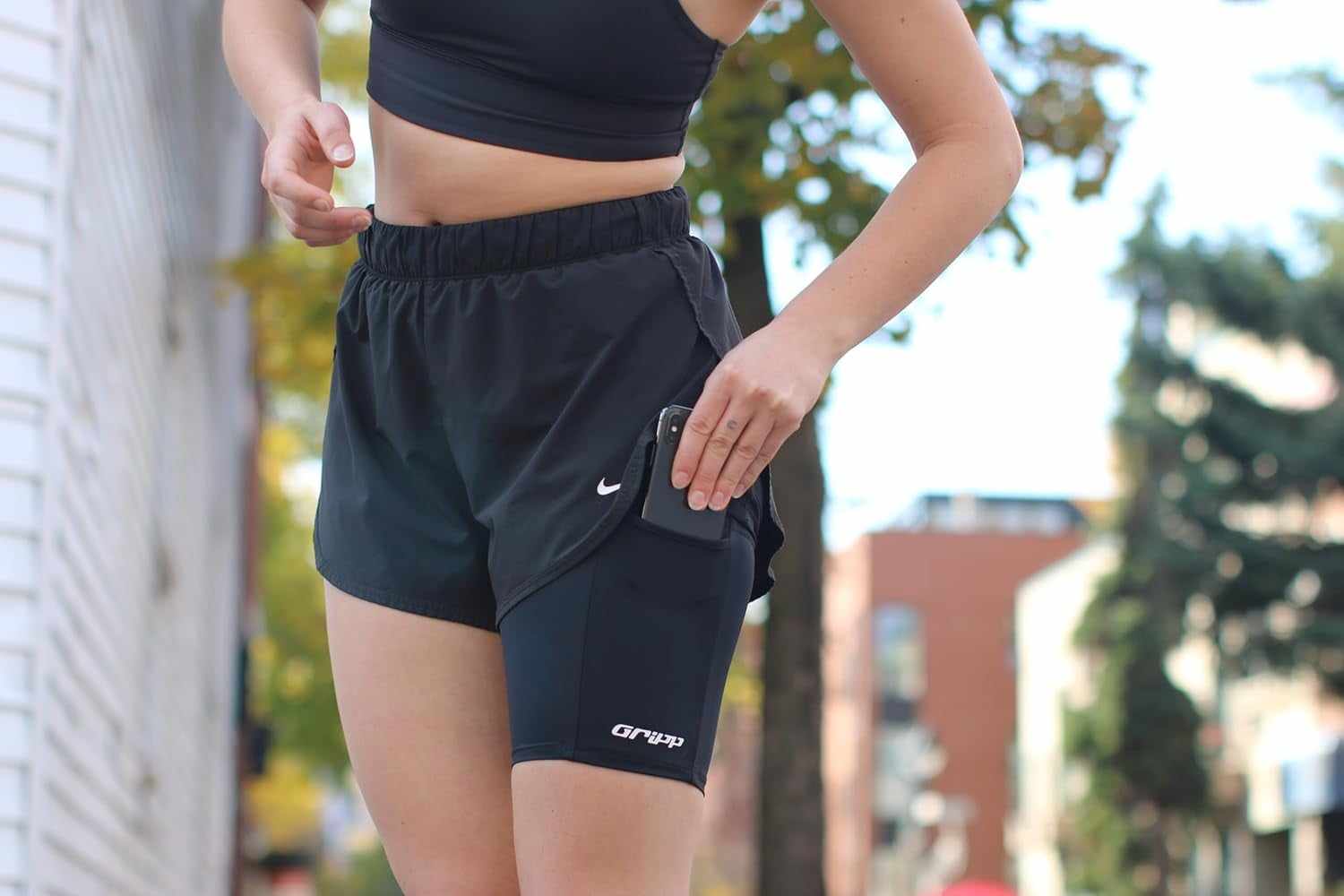
Quick answer: Yes, a running jacket pocket can work for your phone if it fully contains your actual phone and case, closes without strain, and stays stable enough during a short movement test. A zipper only closes the opening. It does not stop a heavy phone from swinging, pulling the jacket, or becoming awkward to reach. If the pocket moves more than you accept, use a closer-to-body option. For one phone, compare an armband or thigh holder. For a phone plus keys, cards, water, or layers, use a belt or vest sized for the full load.
Run four checks before trusting the pocket
1. Does the full phone and case fit?
Test the exact phone and case you run with. The pocket should fully contain them without leaving the phone exposed or forcing the closure. A pocket that fits a bare phone may not fit the same phone in a bulky case.
2. Does the pocket close normally?
Zip or close the pocket without stretching the opening around the phone. The closure should work as designed. If it catches, opens under light movement, or leaves part of the phone exposed, choose another location.
3. Does the jacket stay where you want it?
Walk, jog in place, move your arms, and go up a few steps. Check the phone and the jacket. A chest or inside pocket may keep the phone closer to your torso than a loose side pocket, but the actual result depends on the pocket shape, jacket fit, phone weight, and case.
4. Can you reach it when dressed for the run?
Test access with the layers and gloves you plan to wear. If opening the pocket takes repeated adjustments, decide whether you really need screen access during the run. Setting up music, directions, or tracking before you leave can reduce how often you handle the phone.
Choose by pocket position and total load
| Setup | Start with | What to check | Alternative if it does not work |
|---|---|---|---|
| Phone in a zipped chest or inside pocket | Use the jacket pocket first | Full fit, closure, jacket pull, access | Close-fitting phone holder |
| Phone in a loose side pocket | Run a movement test | Swinging, hem movement, closure | Armband or thigh holder |
| Phone plus keys or cards | Separate hard items | Total load and whether items press together | Fitted running belt |
| Phone plus water or extra layers | Use storage sized for the full load | Loaded fit, closures, access | Running vest |
Use the jacket you already own first
A jacket pocket is the lowest-cost starting point because it adds no accessory. Test each jacket separately. Two zipped pockets can behave differently because pocket depth, placement, jacket fit, and fabric vary.
If you need a broader comparison of pockets, belts, vests, armbands, hand carry, and thigh placement, use the practical phone-carry guide.
Try a five-minute movement test
- Load the pocket with your actual phone and case.
- Close it normally.
- Walk, jog in place, move your arms, and use a few stairs.
- Check whether the phone stays fully contained and whether the jacket shifts more than you accept.
- Repeat with the gloves and layers you plan to wear.
If the setup passes your test, use it. If not, change the pocket, jacket, or carry category before buying more of the same type of gear.
What to use when the jacket pocket does not work
For one phone, a close-fitting armband or thigh holder can move the device away from a loose jacket pocket. For a phone plus small items, a fitted belt provides more capacity. When water or layers are already part of the run, a vest is usually the more practical category.
If your shorts also lack a usable pocket, compare the options in the no-secure-pocket guide.
Where THIGHBAND fits
The 800M THIGHBAND is relevant when you carry one phone, prefer upper-thigh placement, and do not want the phone pulling on a jacket pocket. It is worn high on bare skin under compatible loose shorts. It is not designed to grip over leggings, and it is not storage for water, keys, cards, or layers.
Before choosing it, check your actual phone and case, measure your body using the verified sizing guide, and test the full clothing setup. If winter tights cover the placement area, use a jacket pocket, belt, vest, or another holder that matches those layers.
A jacket pocket is not temperature protection
An inside pocket may reduce direct exposure compared with holding a phone in open air, but do not treat a jacket pocket as insulation or a temperature guarantee. For cold-battery behavior and device-specific checks, read why a phone can lose battery in the cold while running.
FAQ
Is a zipped running jacket pocket enough for a phone?
It can be, if the pocket fully contains your phone and case, closes normally, and stays stable enough during a movement test. A zipper secures the opening but does not guarantee that the jacket will not swing or pull.
Is a chest pocket better than a side pocket for running?
A chest or inside pocket may hold the phone closer to your torso, while a loose side pocket may allow more movement. Test the exact jacket because pocket shape, fit, fabric, phone, and case all matter.
What if my phone makes the jacket bounce or pull?
Move the phone to a closer-fitting pocket or holder. For one phone, compare an armband or thigh holder. For several items, use a fitted belt or vest that matches the full load.
Can I wear THIGHBAND over winter leggings?
No. Its silicone band is designed to grip bare skin and is not designed to hold over leggings. Use it only when your clothing allows the product to be worn as designed.
Should my phone and keys share the same jacket pocket?
Separate them when hard items press or move against each other. Use another pocket, a key clip, or a fitted belt based on the total load and the storage available.